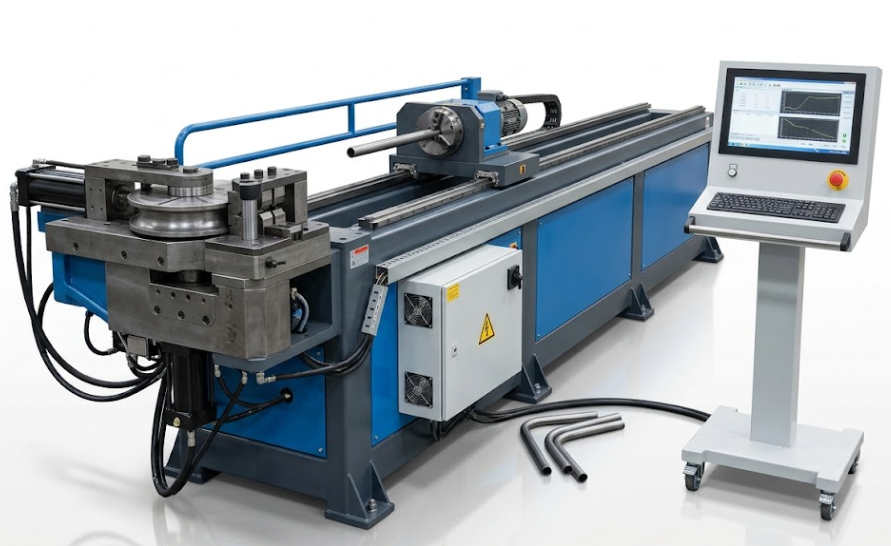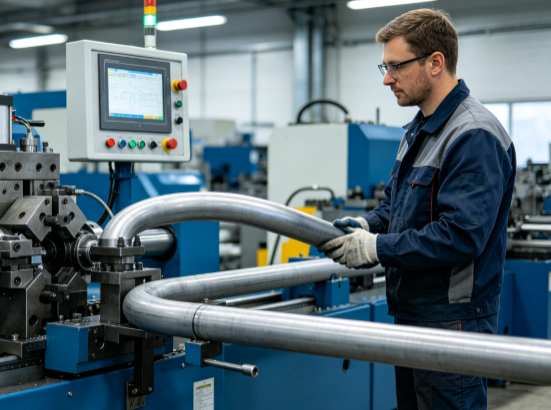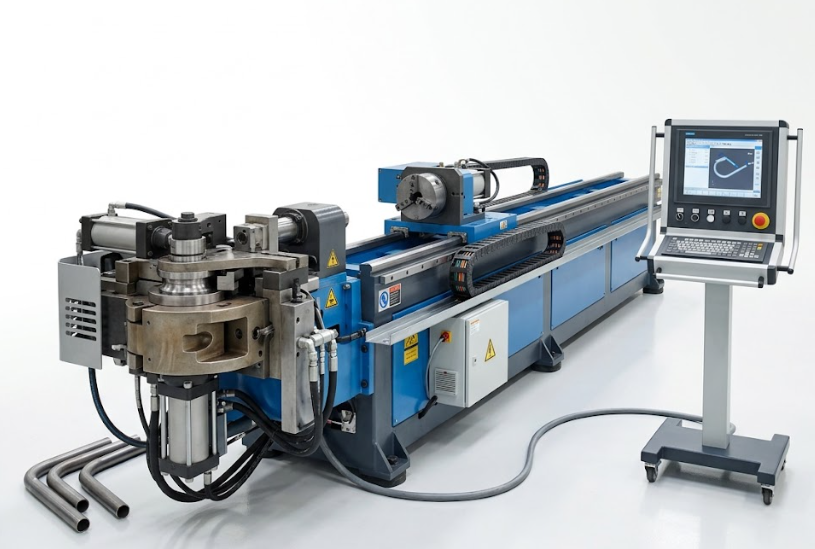
A CNC tube bending machine becomes valuable when it produces the required part repeatedly, with controlled setup and predictable handling. The specification should therefore connect the product drawing to the forming process. This article explains how to plan a machine purchase for automotive tubes, furniture frames, agricultural machinery, HVAC assemblies, fitness equipment, bathroom products, and other applications listed in XYP’s public industry coverage.
Contents
1. Read the part drawing as a process document, 2. Choose the forming architecture, 3. Plan automation and inspection, 4. Control tooling and changeover, 5. Build a supplier acceptance plan, 6. Frequently asked questions
Read the Part Drawing as a Process Document
A drawing tells you more than finished dimensions. Look for bend order, tangent lengths, hole or slot locations, weld interfaces, cosmetic surfaces, and the areas that must remain free of marks. Note whether the part will be powder coated, welded, assembled, or visible to the customer. A tube that looks simple in two dimensions may need rotation control, a long mandrel distance, or a carefully sequenced clamp release.
Material is equally important. Mild steel, stainless steel, aluminum, and other alloys respond differently to force and springback. The same outside diameter does not mean the same process window. Give the supplier the actual material grade and wall thickness, then request a trial using representative stock. If the final product uses several materials, plan separate parameters and tooling checks rather than assuming one setting will suit all of them.
Part requirement | Machine or tooling implication | Evidence to request |
Multiple bend planes | Needs controlled rotation and accurate repositioning. | Axis description and sample sequence. |
Tight centerline radius | May require mandrel, wiper, and special lubrication. | Trial part with ovality and surface review. |
Several radii | May justify multi-stack tooling. | Die layout and changeover method. |
Long finished tube | Needs suitable mandrel working distance and support. | Working-distance calculation. |
Visible finished surface | Requires marking control and stable clamping. | Approved cosmetic sample and inspection points. |
Choose the Forming Architecture
XYP’s product list includes full-servo CNC machines, hydraulic NC machines, and models with different axis counts and die stacks. A 3-axis full-servo machine may be suitable for a standard part family, while 4-axis or 6-axis equipment can support more complex positioning and multi-radius work. Hydraulic NC equipment can be a reasonable option for simpler programs where lower initial complexity is more important than maximum automation.
Published examples include the DW-28CNC-6A-3S with six-axis control and three die stacks, the DW-65CNC-4A-3S for 65 mm capacity, and larger DW-130CNC and DW-168CNC models for heavy-duty work. These are public product descriptions, not a substitute for a project-specific calculation. Confirm the applicable capacity, wall thickness, bend radius, and working distance for your actual material and tooling.
Plan Automation and Inspection Together
Automation is useful when it removes repeatable handling work without making the line difficult to change over. Discuss tube loading, length measurement, rotation, unloading, and transfer to the next process. For a mixed product line, setup clarity may matter more than the highest theoretical cycle speed. Ask how programs are stored, backed up, named, and protected from accidental edits.
Inspection should be planned before the machine arrives. Define the dimensions that control fit: bend angle, tangent length, overall length, rotation, ovality, and surface condition. Use a first-off approval routine and record the program revision, material batch, tooling condition, and measurement results. If the part feeds a welding or assembly operation, include those downstream fit checks in the acceptance sample.
Control Tooling and Changeover
Tube bending quality depends on the complete tooling set. Confirm die diameter, pressure-die geometry, clamp length, wiper selection, mandrel type, lubrication, and any inserts required for thin-wall or tight-radius work. A supplier should explain how tooling is identified and stored, how wear is checked, and which spare parts are recommended for regular production.
Changeover time should be measured in the context of your part mix. A three-stack arrangement can reduce die replacement when multiple radii are used, but it may add tooling cost and require more careful setup. Ask for a changeover procedure with reference points, parameter files, and a verification part. This is more useful than a general claim about fast setup.
Build a Supplier Acceptance Plan
Before placing an order, agree on what the supplier will demonstrate. The acceptance plan can include a defined tube material, approved drawing revision, sample quantity, dimensional checkpoints, cosmetic limits, and the method for handling nonconforming results. It should also state which items are included: machine, standard tooling, custom dies, manuals, training, remote support, spare parts, and shipping preparation.
XYP describes equipment and mold solutions based on customer pipe specifications and processes, as well as remote or on-site commissioning and overseas technical training. Turn these capabilities into deliverables with dates and responsible parties. Confirm the contact route for software, electrical, mechanical, and tooling questions. Clear responsibility reduces delays when a trial part needs adjustment.
Frequently Asked Questions
How do I select the machine diameter?
Start with the largest outside diameter and wall thickness in the planned part family, then check material, radius, forming force, and future products. Do not select only by the current tube diameter.
What does repeatability mean in practice?
It means the machine can reproduce the approved process under defined conditions. Ask what measurement method, material, tooling, and tolerances support the stated figure.
When should I choose a servo CNC model?
Consider servo CNC control when parts require repeatable positioning, multiple axes, automatic programs, or frequent production of complex bend sequences. Simpler work may not need the same configuration.
What should be included in the sample trial?
Use representative material and tooling. Check bend angle, length, rotation, radius, ovality, surface marks, and fit with the next operation. Keep the approved sample as the production reference.
Summary
The best CNC tube bending machine specification is built from the part drawing, material, bend sequence, and production mix. Match capacity and axes to the real process, treat tooling as part of the machine system, and agree on sample trials and acceptance criteria before delivery. This gives buyers a practical way to evaluate a CNC tube bending machine supplier and protect repeat production quality.