1. Introduction: The Geometry That Decides the Machine
I have been specifying CNC tube and pipe bending machines for fabrication shops and OEM production lines for over a decade, and I can tell you that the most expensive machine selection mistake is not buying the wrong brand. It is buying the wrong number of axes.
Here is what that looks like in practice. A fabricator wins a contract for a stainless steel exhaust system with four bends. The first three bends are in the same plane — standard 2D work. The fourth bend transitions to a different plane and requires a different bend radius. The shop quotes the job on a 3-axis machine because the quote looked competitive and the machine was available. The first three bends run perfectly. The fourth bend requires a manual reposition and a tooling change. The cycle time triples. The job loses money.
The problem is not the 3-axis machine. It is a perfectly capable machine for 2D bending. The problem is that the job required spatial bending with multiple radii — and that requires more degrees of freedom than a 3-axis machine can provide.
The global CNC tube bending machine market continues to expand, driven by demand for complex tubular structures in automotive, aerospace, furniture, and HVAC applications. The selection between 3-axis, 5-axis, and 9-axis machines is not a question of which machine is better. It is a question of which machine matches the geometry of the parts you actually produce — today and in the next three to five years.
This guide breaks down the three machine configurations — the axis functions, the geometry capabilities, the tooling implications, and the selection framework that prevents the job that loses money.
2. What Each Axis Actually Does
Before comparing the machine configurations, let me define what each axis does in a CNC pipe bender. The axis naming convention varies by manufacturer, but the functions are consistent.
Y-axis (Bend axis). The primary bending motion. The bending arm rotates around the bend die center, pulling the tube against the die to form the bend. The Y-axis determines the bend angle. Every CNC bender has this axis.
B-axis (Rotation or plane-of-bend axis). The rotation of the tube around its own longitudinal axis. The B-axis determines the plane in which the next bend will occur. A B-axis rotation of 0° keeps the next bend in the same plane. A B-axis rotation of 90° moves the next bend to a perpendicular plane.
C-axis (Feed or booster axis). The linear advancement of the tube through the machine. The C-axis determines the distance between bends — the straight length between the end of one bend and the start of the next.
X-axis (Lateral shift axis). The left-right movement of the bending head relative to the tube centerline. The X-axis allows the machine to bend in a plane that is offset from the tube's original centerline. This is the axis that enables spatial bending — bends that are not in the same plane as the previous bend.
Z-axis (Vertical height axis). The up-down movement of the bending head. The Z-axis allows the machine to adjust the vertical position of the bend, enabling bends that are offset in height as well as in lateral position.
Additional axes (9-axis configuration). The 9-axis machine adds axes for multi-stack tooling rotation, dual-head configuration, or automated material handling. The most common additional axes are the multi-radius stack rotation (which allows the machine to select from multiple bend dies without manual changeover) and the dual-head synchronization (which allows two bends to be formed simultaneously).
Axis | Function | 3-Axis | 5-Axis | 9-Axis |
Y | Bend angle | Yes | Yes | Yes |
B | Plane of bend rotation | Yes | Yes | Yes |
C | Feed / distance between bends | Yes | Yes | Yes |
X | Lateral shift | No | Yes | Yes |
Z | Vertical height | No | Yes | Yes |
Multi-radius stack | Tooling selection | No | No | Yes |
Dual-head / handling | Simultaneous or automated | No | No | Yes |
3. 3-Axis Machines: The 2D Workhorse
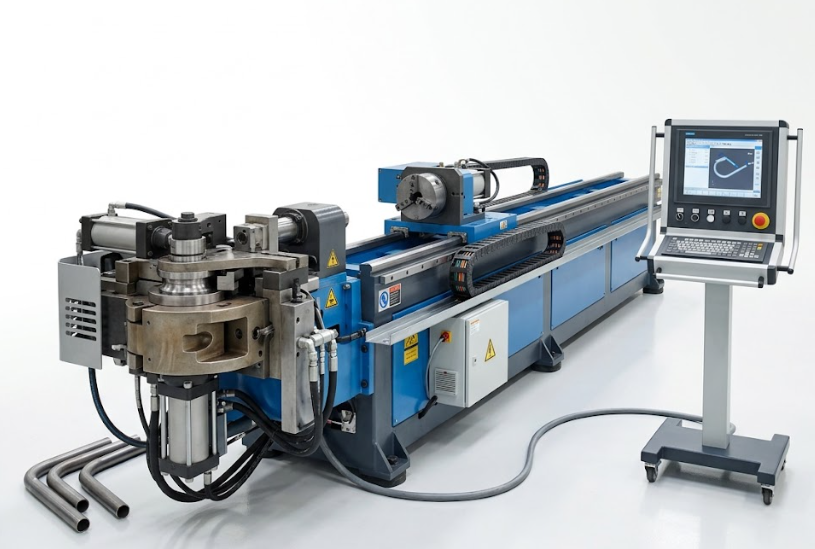
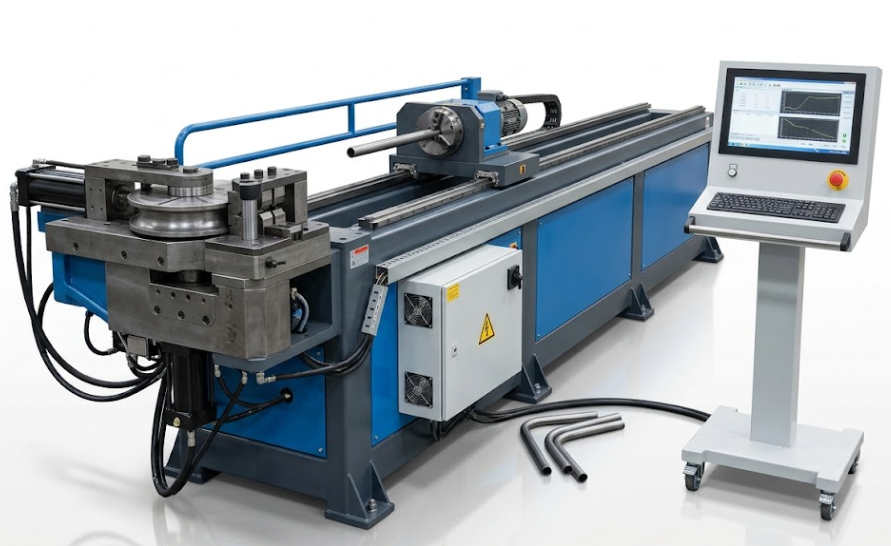
The 3-axis machine is the foundation of the tube bending industry. It has three servo-controlled axes — Y, B, and C — and it handles the majority of tube bending applications in the market.
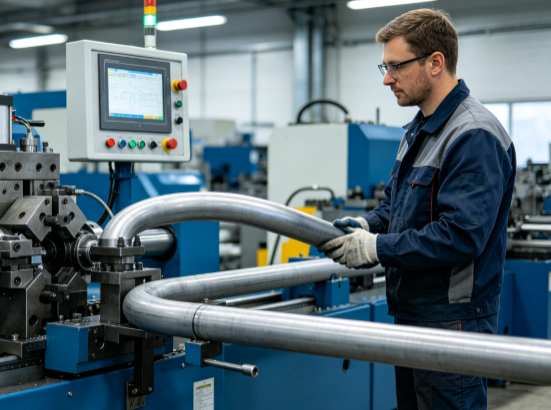
What it can do. The 3-axis machine bends tubes in a single plane. The B-axis rotates the tube to position the next bend, but the bend itself always occurs in the same plane relative to the bending head. The result is a series of bends that all lie in the same flat plane — a 2D shape. This is sufficient for a wide range of parts: automotive roll bars, furniture frames, bicycle frames, handrails, and simple exhaust sections.
What it cannot do. The 3-axis machine cannot produce bends that are offset from the tube centerline. If the part requires a bend that transitions to a different plane — a 3D spatial bend — the 3-axis machine cannot form it in a single setup. The operator must reposition the tube manually or use a different machine.
The typical applications. 3-axis machines are the standard for high-volume production of 2D parts. They are fast, reliable, and cost-effective. The typical bend accuracy is ±0.1° on the bend angle and ±0.1mm on the distance between bends. The production rate depends on the tube diameter and the bend complexity, but a 3-axis machine can produce 300 to 600 bends per hour on simple parts.
The limitation. The 3-axis machine is limited to a single bend radius per setup unless the operator changes the bend die. For parts that require multiple radii, the machine must be stopped, the die changed, and the program restarted. This adds setup time and reduces the effective production rate.
4. 5-Axis Machines: The Spatial Bending Step-Up
The 5-axis machine adds two axes — X and Z — to the 3-axis configuration. The X-axis moves the bending head laterally, and the Z-axis moves it vertically. These two axes enable the machine to bend in planes that are offset from the original tube centerline.
What it can do. The 5-axis machine produces true spatial bends. The bending head can be positioned anywhere in the X-Z plane, which means the bend can occur at any point in three-dimensional space. The B-axis still controls the rotation of the tube, and the C-axis still controls the feed. The combination of X, Z, and B allows the machine to produce complex 3D geometry — bends that transition from one plane to another, bends that are offset laterally, and bends that are offset in height.
What it cannot do. The 5-axis machine is typically limited to a single bend radius per setup. If the part requires multiple radii, the machine must be stopped and the die changed — the same limitation as the 3-axis machine. The multi-radius capability is the distinguishing feature of the 9-axis configuration.
The typical applications. 5-axis machines are used for automotive exhaust systems, structural tubular frames, aerospace hydraulic lines, and any part that requires spatial bending with a single bend radius. The bend accuracy is similar to the 3-axis machine — ±0.1° on the bend angle — but the spatial positioning accuracy is typically ±0.15mm in the X and Z directions.
The geometry matching. The 5-axis machine is the correct specification when the part has bends in multiple planes but a consistent bend radius. If the part has bends in multiple planes and multiple radii, the 5-axis machine will require manual die changes — and the 9-axis machine becomes the more efficient choice.
5. 9-Axis Machines: Multi-Radius and Multi-Stack Capability
The 9-axis machine adds the multi-radius stack and the dual-head or automated handling capability to the 5-axis configuration. It is the most capable and most expensive configuration.
What it can do. The 9-axis machine produces spatial bends with multiple radii in a single setup. The multi-radius stack carries two or more bend dies on a rotating turret. The machine selects the required die for each bend by rotating the stack — no manual changeover, no setup interruption. The dual-head configuration allows two bends to be formed simultaneously, which reduces the cycle time for parts with symmetric geometry. The automated handling axes load and unload the tube without operator intervention.
The typical applications. 9-axis machines are used for complex automotive exhaust manifolds, aerospace ducting, medical device tubing, and any part that requires multiple radii, multiple planes, and high-volume production. The multi-radius stack is the key enabler for parts that would otherwise require two or three separate machine setups.
The cost and complexity. A 9-axis machine costs significantly more than a 5-axis machine — typically 60–100% more. The programming is more complex, the maintenance is more demanding, and the tooling inventory is larger. The machine is only justified when the part geometry and the production volume require the additional capability.
Machine Configuration | Axes | Geometry Capability | Bend Radii per Setup | Typical Cost |
3-axis | Y, B, C | 2D — single plane | 1 | $45,000–$85,000 |
5-axis | Y, B, C, X, Z | 3D spatial — single radius | 1 | $85,000–$160,000 |
9-axis | Y, B, C, X, Z + multi-stack + handling | 3D spatial — multi-radius | 2–4 | $160,000–$320,000 |
6. Head-to-Head: Complete Axis Configuration Comparison Table
Parameter | 3-Axis | 5-Axis | 9-Axis |
Controlled axes | Y, B, C | Y, B, C, X, Z | Y, B, C, X, Z + stack + handling |
Bending geometry | 2D single plane | 3D spatial | 3D spatial |
Bend radii per setup | 1 | 1 | 2–4 |
Multi-radius stack | No | No | Yes — rotating turret |
Dual-head capability | No | No | Yes — optional |
Automated tube handling | No | No | Yes |
Bend angle accuracy | ±0.1° | ±0.1° | ±0.1° |
Spatial positioning accuracy | N/A | ±0.15 mm | ±0.10 mm |
Typical cycle time (4 bends, 1 radius) | 18–25 sec | 22–30 sec | 20–28 sec |
Typical cycle time (4 bends, 3 radii) | Not feasible in one setup | Not feasible in one setup | 30–45 sec |
Programming complexity | Low | Moderate | High |
Tooling inventory | Low | Low | High |
Setup time | 15–30 min | 20–40 min | 30–60 min |
Relative cost | Baseline | +80–120% | +250–400% |
Best application | 2D parts, high volume | 3D parts, single radius | 3D parts, multi-radius, high volume |
7. The Geometry Matching Framework
The selection is determined by three geometry variables: the number of bend planes, the number of bend radii, and the production volume. The matrix below maps the decision.
Number of Bend Planes | Number of Bend Radii | Production Volume | Recommended Machine |
1 (single plane) | 1 | Any | 3-axis |
1 (single plane) | 2+ | Low–Medium | 3-axis with manual die change |
1 (single plane) | 2+ | High | 5-axis with multi-stack (or 9-axis) |
2+ (multiple planes) | 1 | Any | 5-axis |
2+ (multiple planes) | 2+ | Low–Medium | 5-axis with manual die change |
2+ (multiple planes) | 2+ | High | 9-axis |
2+ (multiple planes) + tight tolerances | 2+ | High | 9-axis with automated handling |
How to read this matrix. The number of bend planes is the first gate. Single-plane parts can use a 3-axis machine. Multi-plane parts require the X and Z axes of a 5-axis or 9-axis machine. The number of bend radii is the second gate. Single-radius parts can use a 3-axis or 5-axis machine. Multi-radius parts require the multi-radius stack of a 9-axis machine for efficient production — or a 5-axis machine with manual die changes for low-volume production. The production volume is the third gate. High-volume multi-radius production justifies the 9-axis investment. Low-volume production can tolerate the manual die change.
8. Tooling and Stack Configuration: The Hidden Variable
The tooling configuration is the variable that most buyers underestimate. The machine's axis count determines what geometry it can produce, but the tooling determines how efficiently it produces it.
The bend die. Every bend radius requires a dedicated bend die. The die is specific to the tube diameter and the bend radius. A machine with a single-radius setup can carry one die at a time. A multi-radius stack carries two to four dies on a rotating turret, allowing the machine to select the required die without manual changeover.
The clamp die and pressure die. The clamp die holds the tube against the bend die during the bend. The pressure die supports the tube on the outside of the bend. Both dies must match the tube diameter and the bend radius. The multi-radius stack includes the clamp and pressure dies for each radius in the stack.
The mandrel. For thin-wall tubes, a mandrel is inserted inside the tube to prevent collapse during bending. The mandrel must match the tube inside diameter and the bend radius. The multi-radius setup requires a mandrel for each radius.
The tooling cost. A single-radius tooling set for a 50mm tube costs approximately $3,000 to $8,000 depending on the tube diameter and the bend quality requirement. A multi-radius stack with three radii costs $9,000 to $24,000. The 9-axis machine requires the multi-radius stack, which is a significant additional investment.
Tooling Component | Single Radius | Multi-Radius Stack (3 radii) |
Bend die | $800–$2,000 | $2,400–$6,000 |
Clamp die | $400–$1,000 | $1,200–$3,000 |
Pressure die | $500–$1,200 | $1,500–$3,600 |
Mandrel | $600–$1,500 | $1,800–$4,500 |
Wiper die | $300–$800 | $900–$2,400 |
Stack mechanism | Not applicable | $2,000–$5,000 |
Total per tube diameter | $3,000–$8,000 | $9,000–$24,000 |
9. Case Study: An Automotive Exhaust Fabricator's Axis Upgrade
The most instructive case study for axis configuration selection comes from an automotive exhaust fabricator that upgraded from a 3-axis to a 5-axis machine after losing a contract.
The shop. A fabrication shop with two 3-axis CNC benders and a team of experienced operators. The shop specialized in 2D exhaust pipes for passenger cars — a stable, high-volume business with a consistent product mix.
The new contract. The shop won a contract for a performance exhaust system with four bends. The first three bends were in the same plane — standard 2D work. The fourth bend transitioned to a perpendicular plane and required a different bend radius. The contract volume was 8,000 units per year.
The 3-axis attempt. The shop quoted the job on the 3-axis machine. The first three bends ran at 22 seconds per part. The fourth bend required the operator to remove the tube, reposition it in a fixture, change the bend die, and make the final bend. The total cycle time was 95 seconds per part — more than four times the 2D cycle time. The shop lost money on the first production run.
The evaluation. The shop evaluated a 5-axis machine for the spatial bending capability. The 5-axis machine could form the fourth bend in the same setup as the first three, without repositioning. The cycle time was 32 seconds per part — a 66% reduction from the 3-axis cycle time. The multi-radius requirement was addressed by keeping two bend dies on the machine and changing them manually between production runs — acceptable at the 8,000-unit annual volume.
The 9-axis alternative. The shop also evaluated a 9-axis machine with a multi-radius stack. The cycle time was 28 seconds per part — only 4 seconds faster than the 5-axis machine — but the machine cost 85% more. At the 8,000-unit volume, the 4-second cycle time saving did not justify the additional investment.
The decision. The shop purchased the 5-axis machine. The cycle time dropped from 95 seconds to 32 seconds. The contract became profitable. The 3-axis machines remained in service for the 2D work.
The lesson. The 3-axis machine was the wrong specification for the 4-bend spatial part. The 5-axis machine was the correct specification. The 9-axis machine was over-specified for the volume — the multi-radius stack capability was not justified by the 4-second cycle time improvement at 8,000 units per year. The selection was based on the geometry and the volume, not on a general preference for more capability.
10. The Selection Decision Matrix
Part Geometry | Annual Volume | Recommended Machine | Rationale |
Single plane, 1 radius | Any | 3-axis | Lowest cost, adequate capability |
Single plane, 2+ radii | <5,000 | 3-axis with manual die change | Manual change acceptable at low volume |
Single plane, 2+ radii | >5,000 | 5-axis with 2-die stack or 9-axis | Manual change too slow for high volume |
Multi-plane, 1 radius | Any | 5-axis | X and Z axes required for spatial bending |
Multi-plane, 2+ radii | <3,000 | 5-axis with manual die change | Manual change acceptable at low volume |
Multi-plane, 2+ radii | 3,000–10,000 | 9-axis with multi-radius stack | Multi-radius stack justified by volume |
Multi-plane, 2+ radii | >10,000 | 9-axis with automated handling | Full automation justified by volume |
Tight tolerances, complex geometry | Any | 9-axis | Highest spatial accuracy, automated handling |
11. Practical Sourcing Framework for B2B Buyers
If you are sourcing a CNC pipe bender for a production operation, here is the framework I recommend.
Step 1: Map the part geometry first. Count the number of bend planes and the number of bend radii for every part in the production mix. The part with the highest number of planes and radii determines the machine requirement. Do not buy a machine that only handles the current parts — buy a machine that handles the parts you expect to produce in the next three to five years.
Step 2: Determine the production volume for each geometry class. A multi-radius part at 1,000 units per year does not justify a 9-axis machine. The same part at 20,000 units per year does. The volume determines whether the manual die change is acceptable or whether the multi-radius stack is necessary.
Step 3: Calculate the cycle time for each machine configuration. The 3-axis machine is faster than the 5-axis machine for 2D parts because it has fewer axes to move. The 5-axis machine is faster than the 3-axis machine for spatial parts because it eliminates the manual repositioning. The 9-axis machine is faster than the 5-axis machine for multi-radius parts because it eliminates the die change. The cycle time difference is the number that drives the investment decision.
Step 4: Evaluate the tooling cost for the full production mix. The machine cost is the visible investment. The tooling cost is the hidden investment. A 9-axis machine with a three-radius stack requires three times the tooling inventory of a single-radius machine. The tooling cost must be included in the total investment calculation.
Step 5: Verify the programming and simulation capability. The 5-axis and 9-axis machines require offline programming and simulation to prevent collisions and optimize the bend sequence. The machine supplier should provide the programming software and the training to use it. A machine without the programming capability is a machine that will sit idle.
Step 6: Request a sample part run on the proposed machine. Before committing to the purchase, request a sample run with the most complex part in the production mix. Measure the cycle time, the bend accuracy, and the surface quality. The sample run reveals the actual performance, not the brochure performance.
Sourcing Parameter | 3-Axis | 5-Axis | 9-Axis |
Geometry capability | 2D single plane | 3D spatial | 3D spatial + multi-radius |
Bend radii per setup | 1 | 1 | 2–4 |
Spatial accuracy | N/A | ±0.15 mm | ±0.10 mm |
Cycle time (4 bends, 1 radius) | 18–25 sec | 22–30 sec | 20–28 sec |
Cycle time (4 bends, 3 radii) | Not feasible | Not feasible | 30–45 sec |
Tooling investment | $3,000–$8,000 | $3,000–$8,000 | $9,000–$24,000 |
Programming software | Basic | Advanced | Advanced + simulation |
Best volume range | Any | Any | >3,000 units/year |
12. Frequently Asked Questions
Q: What is the difference between a 3-axis and a 5-axis CNC pipe bender?
A 3-axis machine has Y, B, and C axes — bend, rotation, and feed. It produces bends in a single plane (2D). A 5-axis machine adds X and Z axes — lateral shift and vertical height — which allow the bending head to move in space and produce bends in multiple planes (3D spatial).
Q: When do I need a 9-axis machine instead of a 5-axis machine?
You need a 9-axis machine when the part requires multiple bend radii in a single setup. The 5-axis machine is limited to one bend radius per setup. The 9-axis machine has a multi-radius stack that carries two to four bend dies on a rotating turret, allowing the machine to select the required die without manual changeover.
Q: Can a 3-axis machine produce a 3D bend?
No. The 3-axis machine lacks the X and Z axes that are required to offset the bend from the tube centerline. A 3-axis machine can rotate the tube (B-axis) to change the plane of the next bend, but the bend itself always occurs in the same plane relative to the bending head.
Q: How much does a 5-axis machine cost compared to a 3-axis machine?
A 5-axis CNC pipe bender typically costs 80–120% more than a comparable 3-axis machine. The 3-axis machine ranges from $45,000 to $85,000. The 5-axis machine ranges from $85,000 to $160,000 depending on the tube diameter capacity and the control system.
Q: How much does a 9-axis machine cost?
A 9-axis CNC pipe bender with a multi-radius stack and automated handling typically costs $160,000 to $320,000 depending on the configuration. The cost premium over a 5-axis machine is 60–100%.
Q: What is the cycle time difference between a 3-axis and a 5-axis machine?
For 2D parts, the 3-axis machine is slightly faster because it has fewer axes to move. For 3D parts, the 5-axis machine is significantly faster because it eliminates the manual repositioning that the 3-axis machine requires. In the exhaust fabricator case study, the cycle time dropped from 95 seconds on the 3-axis machine to 32 seconds on the 5-axis machine — a 66% reduction.
Q: What is a multi-radius stack and why does it matter?
A multi-radius stack is a rotating turret that carries two to four bend dies, clamp dies, and pressure dies on a single machine. The machine rotates the stack to select the required die for each bend. The multi-radius stack eliminates the manual die change that would otherwise be required for each radius, reducing the cycle time and improving the production efficiency.
Q: Can I upgrade a 3-axis machine to a 5-axis machine?
In most cases, no. The 5-axis machine requires a different machine bed, different servo motors, and a different control system. The upgrade is not a retrofit — it is a new machine. The 3-axis machine can be retained for the 2D work while the 5-axis machine handles the spatial parts.
13. Final Thoughts
Let me leave you with this.
The choice between a 3-axis, 5-axis, and 9-axis CNC pipe bender is not a choice between a basic machine and an advanced machine. It is a choice between three machine configurations that produce three different classes of geometry. The 3-axis machine produces 2D bends in a single plane. The 5-axis machine produces 3D spatial bends with a single radius. The 9-axis machine produces 3D spatial bends with multiple radii in a single setup.
The data is clear. The 3-axis machine is the cost-effective workhorse for 2D parts. The 5-axis machine is the correct specification for spatial bends with a single radius. The 9-axis machine is the correct specification for multi-radius spatial parts at high volume. The cost premium is 80–120% for the 5-axis and 250–400% for the 9-axis.
The exhaust fabricator case study demonstrates the principle. The 3-axis machine could not produce the 4-bend spatial part at a profitable cycle time. The 5-axis machine reduced the cycle time by 66%. The 9-axis machine offered only a 4-second additional improvement — not enough to justify the 85% cost premium at the 8,000-unit annual volume.