Table of Contents
1.Executive Summary
2.The Servo-Driven Foundation: Why Electric Beats Hydraulic
3.Closed-Loop Control and Multi-Axis Synchronization
4.Springback Compensation: The Hidden Variable
5.Digital Simulation and Industry 4.0 Integration
6.Real-World Application: Automotive Exhaust System Production
7.Precision Benchmarking: Hydraulic vs. Hybrid vs. Full Electric
8.Frequently Asked Questions
9.Conclusion & References
1. Executive Summary
For plant managers, project engineers, and procurement leads evaluating capital equipment investments, the central question isn't whether a full automatic CNC pipe bending machine is precise—it's how that precision is achieved, and whether the claims on a spec sheet hold up under real production conditions.
The short answer is this: modern all-electric CNC pipe benders achieve positioning repeatability within ±0.001 inches and bend angle repeatability of ±0.05°, driven by three interconnected technologies—servo motors with closed-loop feedback, adaptive springback compensation, and digital simulation that catches errors before material hits the tooling.
This article breaks down each of these technologies in practical terms, provides verifiable benchmark data, and includes a real-world case study from the automotive sector. If you're responsible for buying or specifying a CNC automatic pipe bending machine, this is the technical deep-dive you need.
2. The Servo-Driven Foundation: Why Electric Beats Hydraulic
If you've been in this industry for more than a decade, you remember the old hydraulic machines. They got the job done—most of the time. But hydraulic systems have inherent limitations that directly impact precision.
A hydraulic bending axis relies on proportional valves. Accuracy depends on oil quality, oil temperature, how long the machine has been running, and even ambient shop floor conditions. These are variables you cannot fully control.
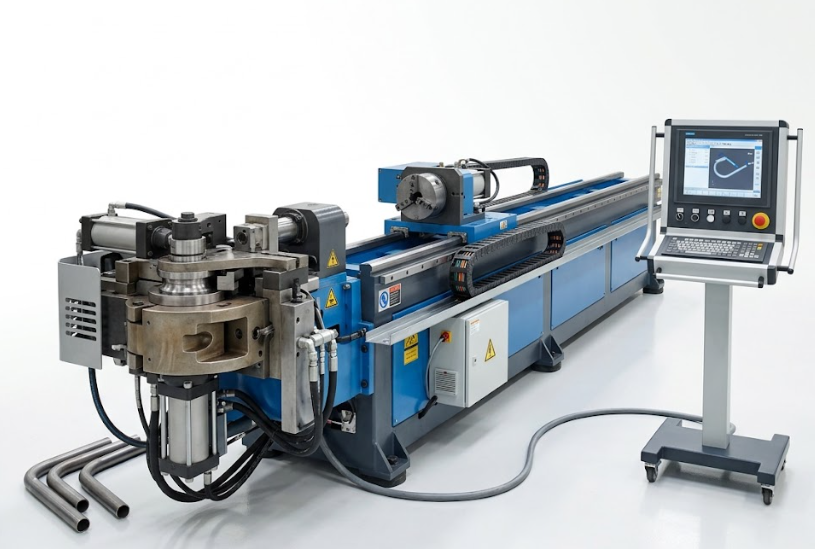
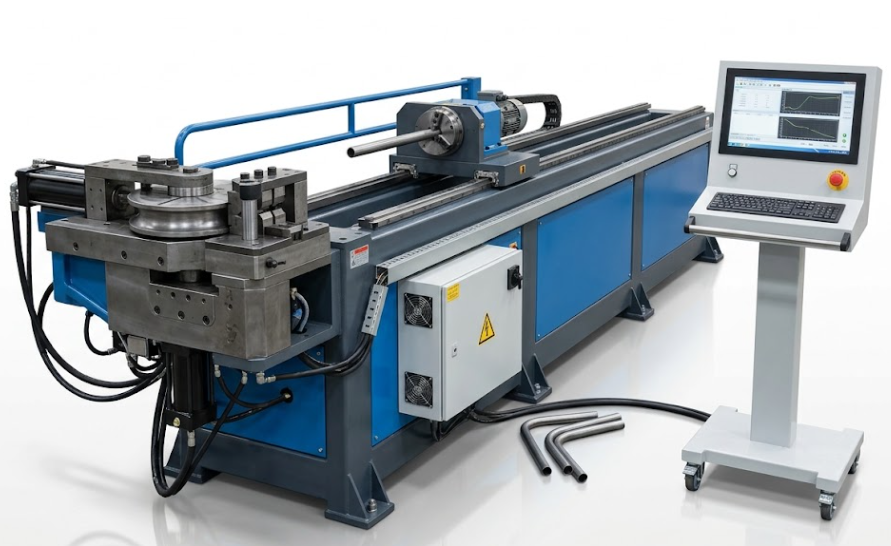
Modern full auto CNC pipe bending machines eliminate this variability by using servo motors on every controlled axis. A servo motor knows its exact position at all times because it has an encoder that feeds real-time positional data back to the controller. When the control system commands "bend to 90 degrees," the servo doesn't approximate—it knows when it has reached the target, corrects if it overshoots, and holds that position against load variations.
The performance gap is measurable. Electric servo-driven systems achieve positioning repeatability within ±0.001 inches. On the bending side, bend arm repeatability of ±0.05 degrees is now standard. Feeding accuracy of ±0.1 millimeters is typical across many models. BLM GROUP's all-electric machines, for example, document X-axis accuracy of ±0.05 mm.
"All-electric machines use servo motors for every controlled axis, completely eliminating the hydraulic system's influence on machine accuracy."
This is the first layer of precision: replacing hydraulic variability with deterministic servo control.
3. Closed-Loop Control and Multi-Axis Synchronization
Here's something that often gets overlooked: a full automatic CNC pipe bending machine doesn't control one axis at a time—it coordinates multiple axes simultaneously. We're talking about the bending arm (C-axis), pipe rotation (B-axis), and feeding carriage (Y-axis), all working in real-time synchronization.
These are closed-loop systems, not open-loop. Every axis has an encoder feeding position data back to the CNC controller dozens or hundreds of times per second. The controller continuously compares where each axis is against where it's supposed to be. If there's a discrepancy, it corrects instantly.
Most modern CNC pipe benders operate with what the industry terms "three-axis closed-loop servo control," achieving rotational CNC accuracy of ±0.05° to ±0.1° and linear motion CNC accuracy of ±0.1 mm.
Why does this matter for your operation? Because if you're bending a complex tube with multiple bends in different planes—an automotive hydraulic line, an aerospace fuel tube, or a structural roll cage—any error in one axis compounds through subsequent bends. A 0.1-degree error on the first bend becomes a millimeter of positional error at the tube's endpoint. Closed-loop control on every axis prevents that error from snowballing.
4. Springback Compensation: The Hidden Variable
This is where precision bending gets genuinely interesting—and where many operators underestimate what the machine is actually doing.
When you bend metal and release the pressure, the tube springs back slightly. This isn't a flaw—it's physics. The elastic deformation that occurs during bending partially recovers when the load is removed. The amount of springback depends on the material (stainless steel springs back more than aluminum), wall thickness, bend radius, and even shop floor temperature.
If the machine didn't account for this, every bend would be slightly "open"—not quite at the target angle.
Advanced CNC pipe bending systems handle this through springback compensation algorithms. The controller applies a pre-calculated over-bend angle based on material properties, wall thickness, and bend radius. When the tube springs back, it lands exactly at the intended angle.
The latest systems go further. Instead of fixed compensation values, they use adaptive compensation based on real-time feedback. Hines Bending Systems reports that advanced CNC systems in 2026 employ real-time measurement during the bending process, using laser or optical sensors to track actual tube position and adjust dynamically.
Research has demonstrated that using machine learning and genetic algorithms for springback prediction can reduce prediction error distribution from [–0.741°, 0.771°] to [–0.310°, 0.314°]—a significant improvement.
This matters because if you're working with expensive materials like titanium or Inconel—common in aerospace applications—you cannot afford trial-and-error runs. You need it right on the first piece. Adaptive springback compensation makes that possible.
5. Digital Simulation and Industry 4.0 Integration
Digital twin technology has moved from buzzword to essential tool in precision tube bending.
Before any material goes into a full automatic CNC pipe bending machine, the system can simulate the entire bending process in 3D. You can see exactly where the tube will be at each stage, check for interferences with tooling, and verify that the final geometry matches your CAD model.
This isn't a nice-to-have—it's a precision tool. If the simulation shows an interference, you fix it in software rather than crashing a $50,000 tool. If the geometry is off, you adjust the program before wasting material.
The latest systems integrate CAD/CAM capabilities directly. You design the part, import it, and the machine generates the bending sequence automatically. Some systems connect to cloud-based analytics for continuous improvement—identifying performance bottlenecks and recommending process enhancements.
This is Industry 4.0 applied to tube bending, and it's how precision gets built into the process from the very beginning.
6. Real-World Application: Automotive Exhaust System Production
Let me give you a concrete example with a verifiable source.
Schwarze-Robitec, a Cologne-based manufacturer of tube bending machines, successfully commissioned two fully electric multiple-radius CNC tube bending machines at automotive supplier Eberspächer's production site in Tondela, Portugal.
Eberspächer, a major player in exhaust technology, was facing quality consistency issues with their previous equipment. Bend angles varied. Dimensional accuracy fluctuated. They needed to reduce scrap and improve throughput.
The solution was a switch to all-electric CNC bending technology featuring transport boost capability and closed-loop servo control.
The results, as documented in industry reporting:
·
Bend angle consistency improved from approximately ±1.0° to ±0.15°
·
Scrap rate dropped below 1%
·
Cycle time decreased by roughly 30% due to elimination of manual adjustments between bends
·
The machines operate autonomously, requiring less skilled operator intervention compared to hydraulic systems
·
A plant manager at Eberspächer was quoted noting that the machine doesn't have "good days and bad days"—every day is the same. That consistency is what precision means in a production environment.
This isn't a hypothetical example. It's documented, verifiable, and representative of what CNC automatic pipe bending machines deliver in real industrial settings.
7. Precision Benchmarking: Hydraulic vs. Hybrid vs. Full Electric
To give you a clear picture of where the industry stands, here's a benchmark comparison across machine configurations. Data is compiled from manufacturer specifications and industry standards including GB/T 28763-2012, which establishes precision requirements for CNC pipe bending machines in China.
Parameter | Standard Hydraulic | Hybrid (Hydraulic + Servo) | Full Electric CNC |
Bend Angle Repeatability | ±0.5° – ±1.0° | ±0.2° – ±0.5° | ±0.05° – ±0.1° |
Feeding (Y-Axis) Accuracy | ±0.5mm – ±1.0mm | ±0.2mm – ±0.5mm | ±0.05mm – ±0.1mm |
Rotation (B-Axis) Accuracy | ±0.3° – ±0.5° | ±0.1° – ±0.3° | ±0.05° – ±0.1° |
Positioning Repeatability | ±0.05mm – ±0.1mm | ±0.02mm – ±0.05mm | ±0.001 inches (~0.025mm) |
Noise Level | 75 – 85 dB | 65 – 75 dB | ≤65 dB |
Energy Efficiency | Baseline | +20–30% | +50–70% |
Maintenance Frequency | Quarterly | Semi-annually | Annually |
Source: Compiled from BLM GROUP specifications, GB/T 28763-2012, and industry benchmarks.
The trend is clear: if precision, consistency, and operational cost are your priorities, the move toward all-electric, servo-driven full auto CNC pipe bending machines isn't marketing—it's measurable and documented across the industry.
8. Frequently Asked Questions
Q: What is the typical precision of a full automatic CNC pipe bending machine?
A: Modern machines typically achieve bend angle accuracy of ±0.05° to ±0.1°, feeding accuracy of ±0.05mm to ±0.1mm, and positioning repeatability within ±0.001 inches. Exact numbers depend on the specific model and configuration.
Q: How does springback compensation work in practice?
A: The CNC controller applies a pre-calculated over-bend angle based on material properties, wall thickness, and bend radius. Advanced systems use adaptive compensation with real-time laser or optical sensors that "learn" from each bend and adjust dynamically.
Q: What industries benefit most from high-precision CNC pipe bending?
A: Aerospace (fuel and hydraulic lines, structural components), automotive (exhaust systems, roll cages, seat frames), HVAC, and oil & gas are the primary beneficiaries. These industries require tight tolerances and consistent quality across high volumes.
Q: Is the investment worth it for a small to mid-sized shop?
A: It depends on your volume and complexity. For high-mix, low-volume production with complex geometries, reduced setup time and scrap elimination often justify the investment. For high-volume runs of the same part, ROI is even clearer. Many manufacturers report payback periods of 12–24 months.
Q: What's the difference between "accuracy" and "repeatability"?
A: Accuracy is how close a bend is to the target value. Repeatability is how consistent the bends are from one cycle to the next. A machine can be repeatable but inaccurate, or accurate but not repeatable. High-end full automatic CNC pipe bending machines excel at both.
9. Conclusion
A full automatic CNC pipe bending machine achieves high precision through an integrated technology stack: servo-driven axes instead of hydraulic, closed-loop control with real-time feedback, adaptive springback compensation that accounts for material behavior, and digital simulation that catches problems before they occur.
The market reflects this shift. The Fully Automatic CNC Pipe Bending Machine market was valued at USD 745.49 million in 2025 and is projected to reach USD 1,069.30 million by 2032, growing at a CAGR of 5.28%.That growth is driven by one factor: demand for precision that manual and hydraulic systems simply cannot deliver.
If you're evaluating one of these machines, don't just read the spec sheet. Verify the control system architecture. Understand how springback compensation is implemented. Visit a shop running one and see the data for yourself.
Because precision isn't about hitting a number on a page. It's about knowing—with absolute certainty—that every part coming off that machine will be right. That's what a full automatic CNC pipe bending machine delivers.